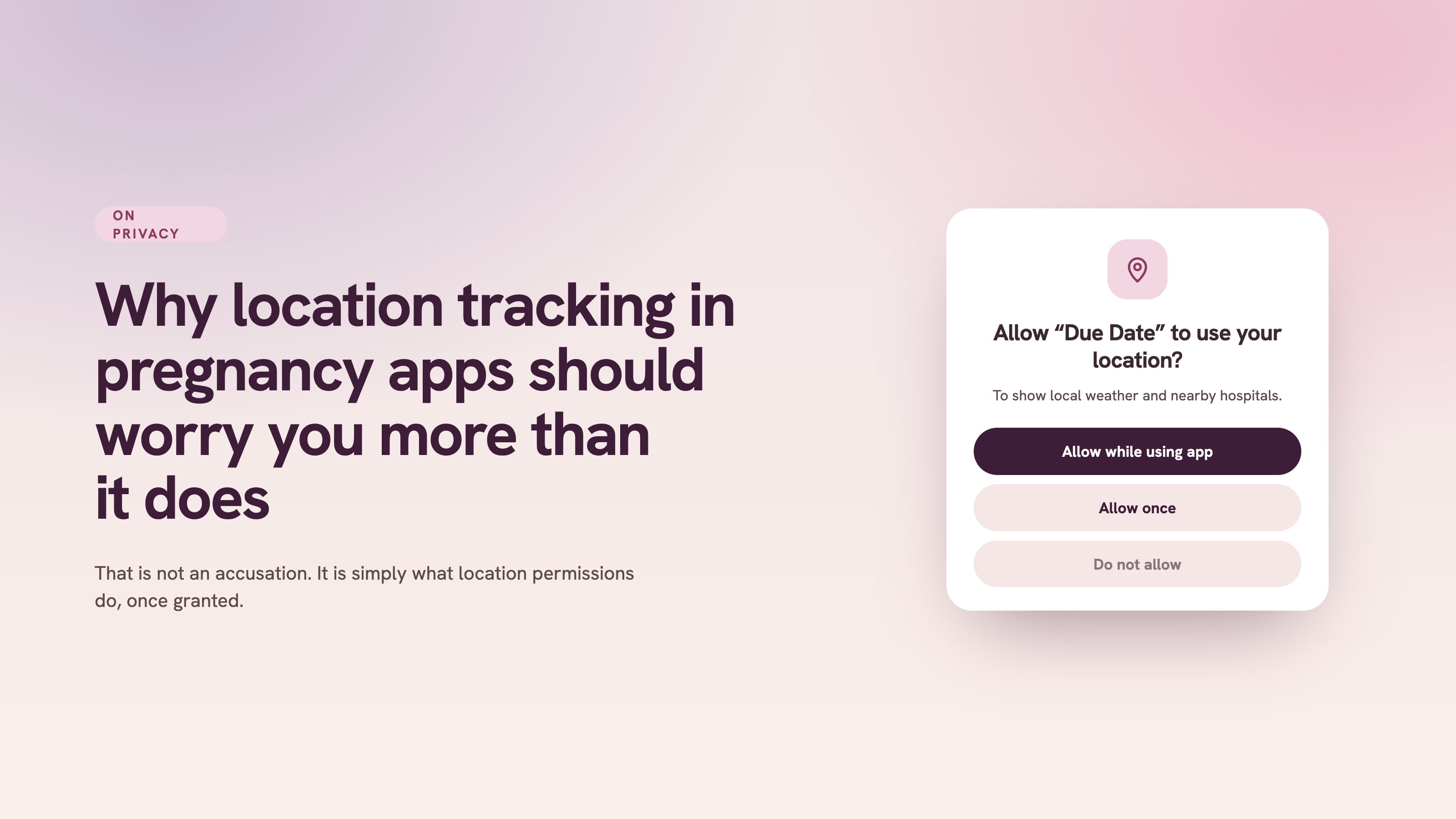
Your due date app probably knows where you live. It may also know where you work, where you sleep, and where you go at two in the morning when you cannot sleep at all.
That is not an accusation. It is simply what location permissions do, once granted, on a phone running an app that checks in regularly.
What location data an app can actually see
There are two broad kinds of location tracking. Coarse location gives an app your general area, useful for showing you a weather forecast or a time zone. Precise location gives an app your exact coordinates, accurate to a matter of meters, updated continuously if the app is allowed to run in the background.
Many pregnancy apps ask for precise location during setup, often with a reason that sounds practical: to show local weather, to recommend nearby hospitals, to personalize your experience. Once granted, that permission does not usually switch off when the stated reason is satisfied. It stays on, and the app keeps collecting.
Background app refresh makes this worse. Many phones allow apps to continue running quietly even when closed, checking in periodically and updating whatever data they are permitted to collect. A location permission granted once during setup can keep working in the background for months, long after you have forgotten agreeing to it, unless you go back into settings and turn it off yourself.
Why a due date app needs your location at all
This is the honest question to sit with. A pregnancy tracker exists to log your weeks, your symptoms, your appointments. None of that requires knowing your physical coordinates. A due date does not change based on where you are standing.
When an app requests location anyway, the more likely explanation is that location data has value beyond the stated feature. It can be matched with other data points: which stores you visit, which hospital you are near, whether you have moved into a new home, whether your daily pattern has changed in a way that suggests a life event. Advertisers pay for this kind of signal. A pregnant person moving between a specific set of locations is a valuable thing to know, commercially.
Marketing teams describe this kind of information as a signal, a small piece of behavioral data that becomes valuable once it is combined with enough other signals. On its own, knowing someone is near a particular pharmacy means very little. Combined with pregnancy status, a repeated pattern of visits to a specific clinic, and timing that lines up with a due date, that same signal becomes something a marketing platform can act on with real precision.
How location data gets used once it leaves your phone
Once location data leaves your device and reaches a server, you lose visibility into what happens next. It might be used only to improve the app. It might be shared with an analytics partner. It might be sold, aggregated with other users, and used to build location based advertising profiles, all of which can be entirely legal under a privacy policy you agreed to during setup without reading closely.
The concerning part is not any single use. It is the combination: pregnancy status, plus precise location, plus a timeline. That combination can reveal a due date, a due hospital, a home address, and a daily routine, all from data most people never think of as sensitive in the moment they grant the permission.
What no location tracking actually looks like
Zorya does not ask for your location, because nothing in the app requires it. There is no weather widget, no store finder, no feature that depends on where your phone happens to be. Your week, your symptoms, your kick counts, your contraction timings, all of that is information you type in yourself, and none of it needs to be matched against where you are standing to be useful to you.
This is architecture, not a policy. It cannot be changed by a future terms of service update, because there is no permission being requested in the first place, and nothing sitting on a server waiting for a new use case to be found for it.
An app that never asks for a permission cannot misuse that permission later, cannot have it exposed in a data breach, cannot have it repurposed after a change in company ownership or business model. The safest data is the data that was never collected in the first place.
If you want to check your current app, it takes two minutes. Go into your phone settings, find the app, and look at what permissions it holds. If it has access to your precise location and you cannot think of a single feature that needs it, that access is doing something other than what you assumed. It is worth asking what, and worth asking who benefits from the answer.

Leave a Reply