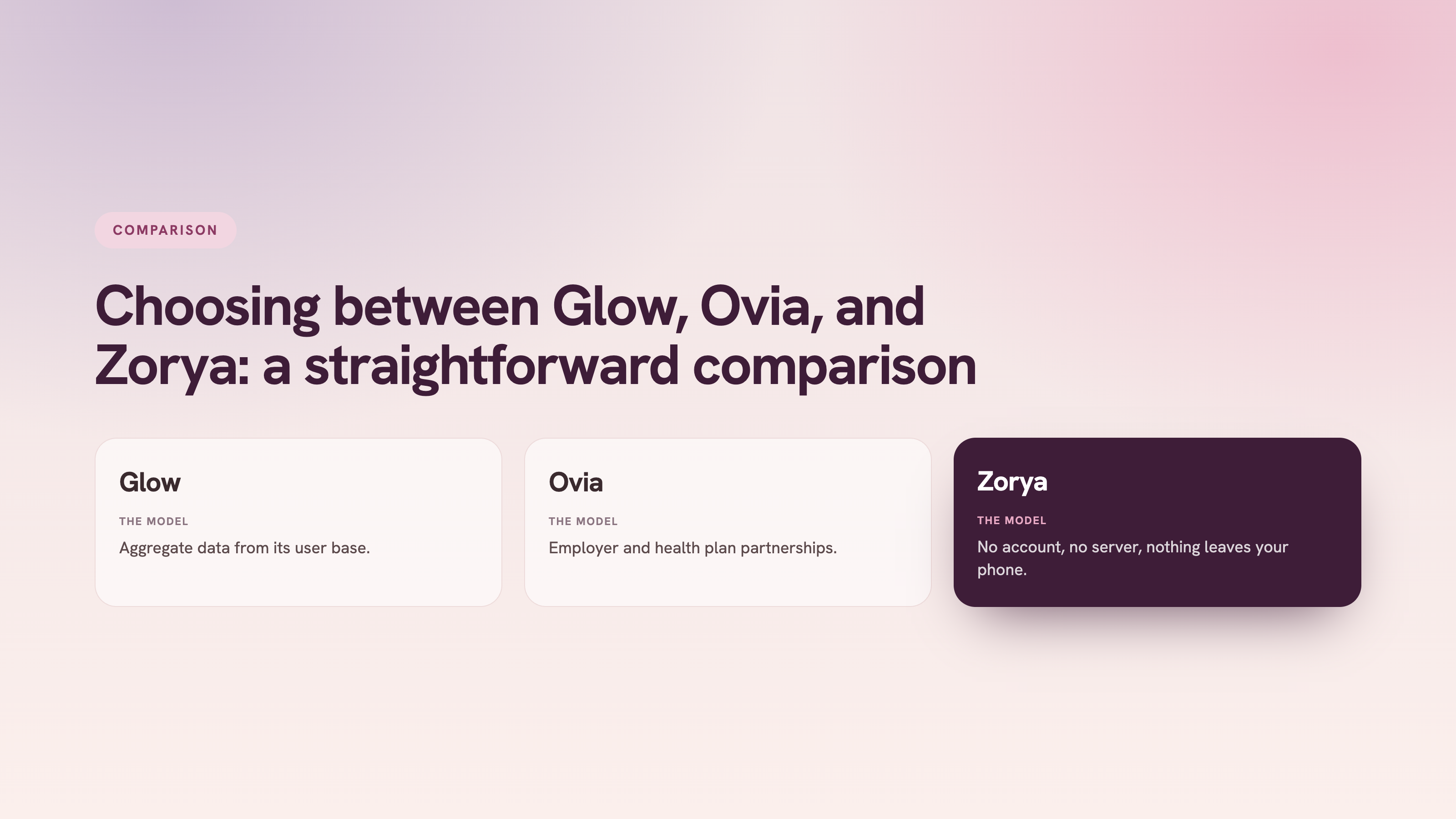
Glow and Ovia both built their reputation on data. Glow started as a fertility app built around aggregate data from its user base, showing you patterns drawn from thousands of other cycles. Ovia grew a following partly through employer and health plan partnerships, where the app is offered as a benefit and data may be shared with those partners in aggregate form. Both are established, both are widely used, and both operate on a model worth understanding clearly before you decide what you want from a pregnancy app.
What Glow and Ovia offer
Glow leans on community and shared data. Part of its value proposition is showing you how your symptoms and patterns compare to a large pool of other users, which some people find reassuring and genuinely useful for understanding what is common.
Ovia offers detailed tracking tools and has built partnerships with employers and insurers, sometimes providing the app free through a workplace benefit. That model has drawn scrutiny in the past, since it raises a real question: when an app is provided through your employer, who exactly can see what you enter, even in aggregate or de identified form.
Both apps have been around for a long time, long enough to have gone through their own periods of scrutiny over data practices, changes in ownership, and updates to their privacy policies. That history is worth knowing about, not as a reason to dismiss either app outright, but as a reminder that a company built around an account and cloud model will keep making decisions about your data long after you first signed up, decisions you will not necessarily be consulted on.
Both apps require an account. Both store your data on a server rather than only on your device. That is simply how the model works, and it enables features like the community comparisons Glow offers and the reporting Ovia provides to its partners.
The account and cloud question
This is the point worth sitting with regardless of which app you are considering. An account means your data exists on a server somewhere, tied to your identity, accessible to the company that built the app and to whatever partners its privacy policy names. Aggregate and de identified are terms worth reading closely, because de identification is not always as complete as the word suggests, particularly when combined with other data points like location or timing.
It is also worth remembering that a privacy policy is not fixed. Companies update them regularly, and continued use of the app after an update usually counts as acceptance of the new terms, whether or not you actually read what changed. This is not a flaw specific to Glow or Ovia. It is a structural feature of any app built around an account, and it is worth factoring into your decision regardless of which cloud based app you are considering.
Zorya does not use this model at all. There is no account, because there is no server for an account to exist on. Your data stays on your device. It cannot be aggregated with other users, shared with an employer partner, or included in a benchmark, because it never leaves your phone to be combined with anything.
Community features versus a private record
The honest tradeoff here goes both directions. Glow offers a sense of shared experience that some people find valuable during a time that can feel isolating. Ovia offers a broad feature set, sometimes at no direct cost through a workplace plan. Neither of those things exists in Zorya, because they require exactly the kind of shared, centralized data that Zorya was built to avoid.
What Zorya offers instead is a record that is entirely your own, viewed only by you, never compared against anyone else, never reported to an employer or a partner in any form. It is a narrower promise. It is also a more complete one.
How to decide
If community comparison and workplace integration matter to you, and you are comfortable with your data existing on a server managed by someone else, Glow and Ovia both offer real value built specifically around that model.
If you would rather your pregnancy stay entirely between you and your phone, without wondering what aggregate or de identified data ends up meaning in practice, Zorya was built as the alternative. Look at what each app asks you to trade, your data for community, your data for a workplace benefit, or nothing at all in exchange for a smaller feature set, and pick the version of that trade you can actually live with for the next several months. There is no wrong choice here, only a choice that matches what you actually value more, connection and convenience, or a record that stays entirely out of reach of anyone but you.

Leave a Reply